
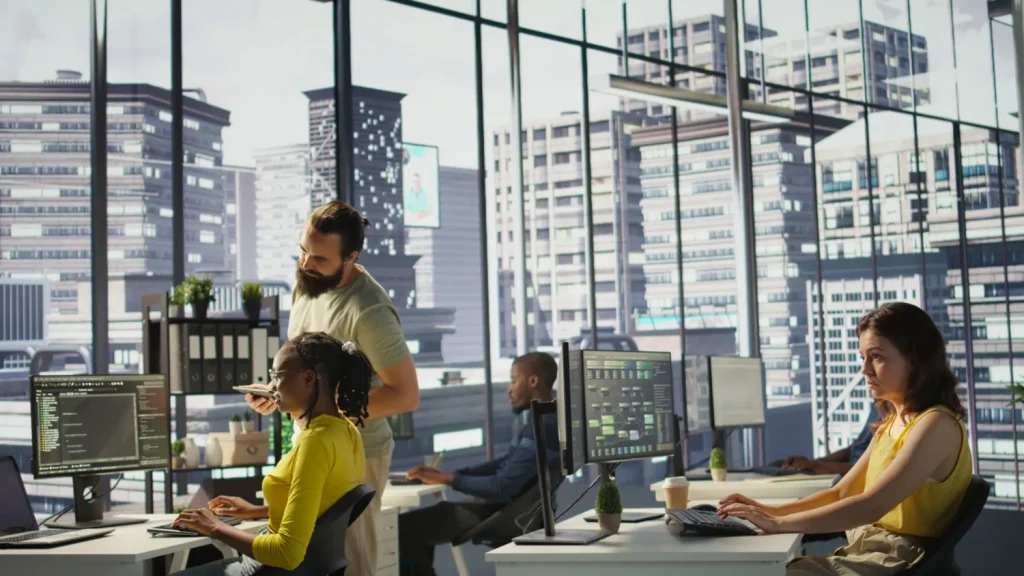
For years, companies have treated workplace transformation mainly as a technology challenge. They invested in cloud platforms, messaging tools, project management software, cybersecurity systems and video conferencing solutions. These tools have changed the way teams communicate and operate. They have made remote work possible, accelerated decision-making and reduced the need for constant physical presence.
But software alone does not create a smarter workplace.
A truly effective workplace is built at the intersection of digital tools and physical environments. Companies need platforms that help people collaborate, but they also need spaces that support focus, creativity, meetings, informal exchanges and company culture. The challenge is no longer to choose between remote work and the office. The real challenge is to design a work ecosystem where technology and space reinforce each other.
This is where the concept of a smarter workplace becomes essential.
Why digital tools changed the way companies work
Digital tools have transformed the daily operations of modern businesses. Teams can now work across locations, time zones and organizational structures with far more flexibility than before. Documents are shared instantly, meetings can happen online, and project updates are no longer limited to face-to-face discussions.
This evolution has made work more fluid. It has also created new expectations. Employees now expect access to information from anywhere. Managers expect faster reporting. Clients expect responsiveness. The workplace is no longer defined only by an office address, but by a set of connected tools and practices.
The rise of hybrid work reflects this shift. Many companies now operate with employees alternating between remote work, office presence and third-party locations. This model offers flexibility, but it also creates a more complex coordination challenge.
When digital tools are well implemented, they reduce friction. When they are poorly integrated, they create overload. Too many platforms, unclear communication channels and duplicated information can quickly weaken productivity. Technology must therefore be structured around real work habits, not added randomly.
A smarter workplace starts with this principle: tools must serve the way people work, not force people to adapt to inefficient systems.
The limits of a software-only approach
A company can have the best collaboration software in the world and still struggle with communication, engagement or creativity. The reason is simple. Work is not only transactional. It is also relational.
Digital tools are excellent for coordination. They help track tasks, share files and organize information. But they do not fully replace the value of physical presence. Some conversations are easier when people are in the same room. Some ideas emerge more naturally during informal exchanges. Some strategic decisions require attention, nuance and trust that are harder to build through screens.
This does not mean companies should return to old office habits. It means they should stop treating the office as a default location and start treating it as a strategic resource.
A meeting room, a lounge area, a quiet workspace or a flexible project room can each serve a specific purpose. The physical workplace becomes valuable when it is intentionally designed around use cases: collaboration, focus, creativity, onboarding, confidential discussion or team alignment.
Digital tools support continuity. Physical spaces support depth.
Physical space still shapes productivity
The design of a workspace affects the way people behave. A noisy environment can damage concentration. A poorly organized meeting room can make collaboration feel heavy. A rigid office layout can limit adaptability. On the other hand, a well-designed workspace can improve comfort, reduce stress and make work feel smoother.
This is not only a matter of aesthetics. Workplace design influences attention, movement, social interaction and mental availability. A smarter workplace gives employees the right environment for the task they need to accomplish.
For example, focused work requires quiet zones and minimal interruptions. Creative work benefits from flexible spaces where people can move, write, discuss and visualize ideas. Client meetings require professional and reassuring environments. Informal exchanges need comfortable areas where conversations can happen naturally.
This is why many companies are moving away from the idea of a single, fixed office model. Instead, they look for adaptable environments that can evolve according to team needs. In this context, premium operated offices and coworking spaces can help companies combine flexibility, service quality and professional standards without carrying the full operational burden of a traditional office.
The physical workplace becomes smarter when it is not just occupied, but actively used with intention.
Connecting digital workflows with real-world collaboration
One of the biggest challenges in modern organizations is connecting digital workflows with physical collaboration. A team may use digital dashboards, shared documents and project management tools every day, but still need moments of in-person alignment to solve complex problems.
The smartest companies do not oppose these two dimensions. They connect them.
Before a workshop, teams can use digital tools to collect data, prepare documents and clarify objectives. During the physical session, they can focus on discussion, decision-making and creative work. After the meeting, software takes over again to track actions, assign responsibilities and maintain momentum.
This creates a complete loop. Digital tools prepare and sustain collaboration. Physical spaces intensify it.
A smart workplace therefore requires more than good software. It requires a clear understanding of when people need to connect online and when they need to meet in person. Without this distinction, companies either overload calendars with unnecessary meetings or rely too heavily on asynchronous communication for topics that require real discussion.
The goal is not to bring everyone back to the office every day. The goal is to make physical presence meaningful.
Security and confidentiality in the modern workplace
As companies combine digital tools and flexible work environments, security becomes a central concern. Data must be protected, but so must conversations, devices and access to professional spaces.
Cybersecurity is often discussed in relation to software, networks and cloud platforms. Frameworks from organizations such as NIST highlight the importance of identifying, protecting, detecting and responding to digital risks. But in hybrid work environments, security also has a physical dimension.
Confidential meetings need appropriate rooms. Employees working on sensitive projects need secure environments. Visitors, devices and shared spaces must be managed carefully. A smart workplace considers both digital and physical security as part of the same system.
This is especially important for companies handling client data, strategic information, financial documents or intellectual property. A poorly managed workspace can create risks even if the software stack is secure.
The modern workplace must therefore be designed as a controlled environment, not just a comfortable one.
Employee experience as a performance factor
A smarter workplace is not only about efficiency. It is also about employee experience. People perform better when their environment supports their needs.
This includes access to reliable tools, comfortable spaces, clear processes and services that reduce everyday friction. If employees waste time looking for meeting rooms, dealing with technical issues or working in unsuitable conditions, productivity suffers.
A well-designed workplace improves the daily experience by making work easier. Employees know where to focus, where to collaborate, where to meet clients and how to access the tools they need.
The concept of employee experience has become increasingly important because companies understand that engagement is influenced by the full work environment. This includes management, culture, tools and physical conditions.
A smart workplace does not simply ask employees to be productive. It gives them the conditions to be productive.
Flexibility without fragmentation
Flexibility is one of the major promises of the modern workplace. But flexibility can also become chaotic when it is not structured.
If everyone works from different places without clear rules, collaboration becomes harder. If office space is underused or poorly organized, costs increase without delivering value. If digital tools are not standardized, information becomes fragmented.
The challenge is to create controlled flexibility. Employees should have options, but the organization still needs clarity. This means defining when teams meet, how spaces are used, which tools are official and how information flows between remote and physical environments.
A smarter workplace is not random. It is flexible by design.
This is where operated and serviced workplace models can be useful. They allow companies to access professional environments without managing every detail internally. Services, maintenance, meeting spaces and daily operations can be structured in a way that supports the business rather than distracting from it.
Flexibility becomes valuable when it reduces friction, not when it adds complexity.
The role of workplace services
Behind every effective physical workplace, there is an operational layer. Cleaning, maintenance, catering, reception, room management, IT support and space planning all affect the quality of the work experience.
These services are often invisible when they work well. But when they fail, everyone notices. A meeting room that is unavailable, a technical issue during a client presentation or an uncomfortable workspace can immediately damage the experience.
In a smarter workplace, services are not secondary. They are part of the performance infrastructure.
Companies increasingly understand that managing a workspace is a profession in itself. The more they expect flexibility, comfort and reliability, the more they need operational excellence behind the scenes.
This is one of the reasons why modern workplace solutions are moving toward integrated service models. Businesses want spaces that are not only well located, but also well managed.
Building a smarter workplace strategy
To build a smarter workplace, companies should begin with real needs rather than trends. The question is not “Should we use more software?” or “Should we reduce office space?” The question is “How do our teams actually work, and what environment helps them perform better?”
This requires observing work patterns. Which tasks are best done remotely? Which activities require in-person collaboration? Which teams need quiet environments? Which moments are critical for culture and alignment?
Once these needs are identified, the company can align three dimensions: digital tools, physical spaces and operational services.
The smartest workplace strategies are not built around technology alone. They are built around use. Every tool, room and service should have a clear purpose.
This approach avoids overinvestment in unnecessary platforms or underused offices. It also helps companies create a more coherent employee experience.
Why the future workplace will be hybrid, but intentional
The future of work is unlikely to be fully remote or fully office-based. Most companies will continue to combine different modes of work. The question is whether this hybrid model will be improvised or intentional.
An improvised hybrid workplace creates confusion. People do not know when to come in, which tools to use or how to collaborate efficiently. An intentional hybrid workplace gives structure. It defines the role of digital tools, the purpose of physical spaces and the moments when teams should gather.
This is where smarter workplace thinking becomes essential.
Companies that succeed will be those that treat workplace design as a strategic decision, not an administrative task. They will understand that software, space and services must work together.
A digital platform can connect people. A physical space can deepen collaboration. A well-managed workplace can make both more effective.
Conclusion
A smarter workplace is not built by choosing between digital tools and physical spaces. It is built by connecting them.
Software gives companies speed, flexibility and continuity. Physical spaces provide focus, trust, creativity and shared experience. Workplace services ensure that everything works smoothly in daily practice.
When these elements are aligned, the workplace becomes more than a place or a set of tools. It becomes a performance system.
For modern companies, the challenge is no longer simply to offer remote access or office desks. The real challenge is to create an environment where people can work better, collaborate more effectively and feel supported wherever they are.
The companies that understand this balance will be better prepared for the future of work.